
So, I was clipping my toenails the other day when it suddenly occurred to me that there’s really no more than a shade of difference between an aphorism and an epigram.
Before I go any further, by the way, I want to publicly acknowledge how grateful I am to have toenails that require only relatively infrequent trimming to be licensed for exposure in polite society.
You’d be absolutely shocked if I told you just how many of my male friends have toenails that have been officially recategorized as unidentifiable keratinous growths, and as such deemed legally disallowed from making appearances at public swimming pools and beaches. Honest to god, I make them step into buckets of Clorox™ before they’re allowed past my front door.
Now, where were we. Ah, yes. Aphorisms and epigrams. I’ve been reading a book about the history of aphorisms, The World in a Phrase by James Geary, who, like me, “loved the puns, paradoxes and clever turns of phrase” presented in the best of them. If you need an example, here’s one from François-Auguste René de Chateaubriand (Yes, there was such a writer.) “Love decreases when it ceases to increase.” Geary says what defines it as an aphorism is that it’s short, personal, philosophical and has a ‘twist.’
We don’t disagree about that because, well … we have ‘dis agreement between ‘da two of us.
And in that bit of punning lies the crux of my opening point. That previous sentence (We don’t disagree, etc.) may look and sound like it could belong in the family of aphorisms, but it’s really more of an epigram. And now, I suppose, it’s incumbent on me to explain the difference – not an easy task when even the internet concedes that ‘epigram’ and ‘aphorism’ are often used interchangeably. The best it can come up with is that the latter generally aims to highlight a universal principal of some kind, while the former – although it may contain a dollop of wisdom – puts most of its money on wit and cleverness.
An epigram, perhaps, can be thought of as a poor man’s aphorism. That explains where the money went.
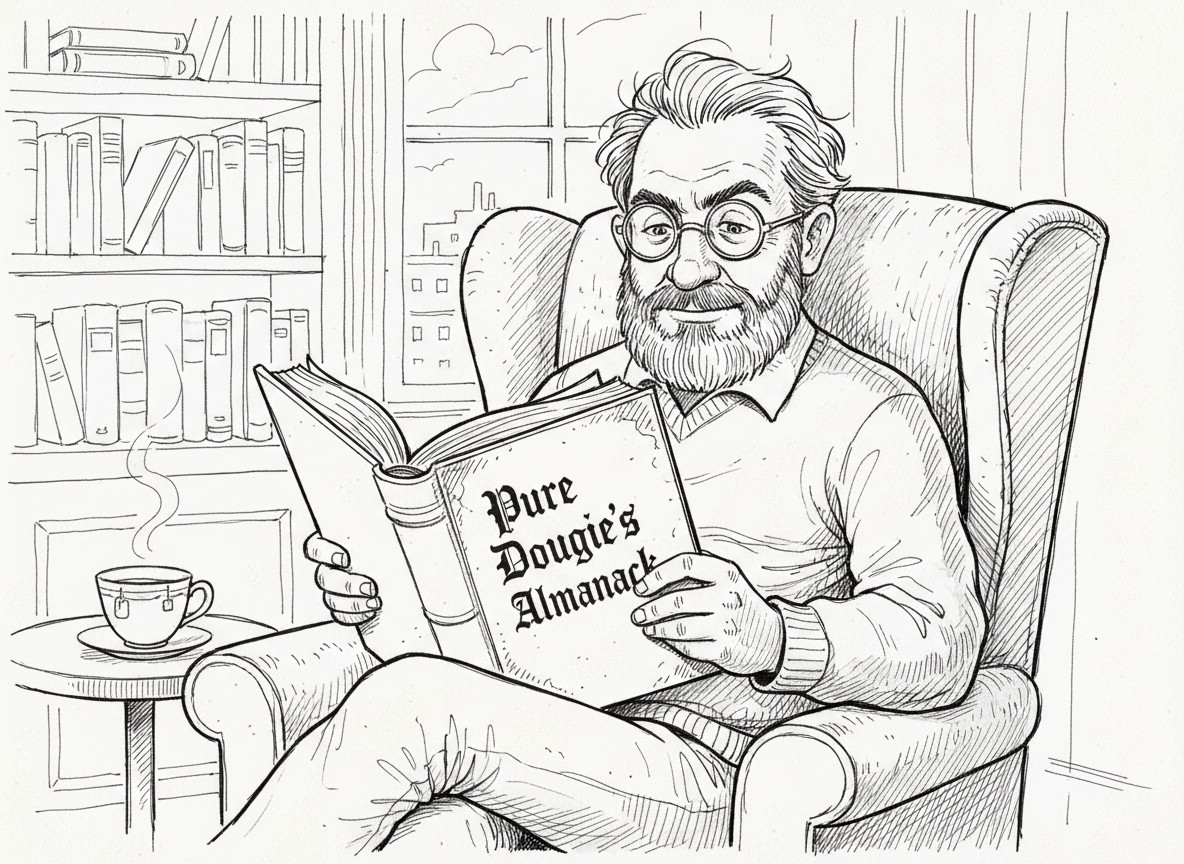
Nothing, however, can explain where I’m going next, which is on a revisionary trek through Benjamin Franklin’s Poor Richard’s Almanack in search of modifications relevant to life in the 21st century. They could be aphorisms. They could be epigrams. They could amount to nothing more than silly sayings that never made it to Bazooka Bubble Gum™ wrappers.
What they cannot be, however, is ignored. You’ve come too far for that.
* * *
“Women are books, and men the readers be.” Although it DOES seem like the guys have to turn to dictionaries way too often.
“There cannot be good living where there is not good drinking.” It’s impossible for me to come up with any words to improve on that observation. Mostly because my mouth is full of wine.
“Fish and visitors stink in three days.” Which explains why the weekend lasts only two.
“Clean your finger before you point at my spots.” Unless pointing at my spots was what made your finger dirty in the first place.
“He that drinks his cider alone, let him catch his horse alone.” This, after that ‘good living, good drinking’ thing? Pretty harsh, dude.
“There are three faithful friends: an old wife, an old dog and ready money.” Yeah. And guess which one I’m choosing!
“Today is yesterday’s pupil.” Which means the poor son of a bitch never had a chance of getting to class on time.
“Great modesty often hides great merit.” Sometimes, though, it just means the guy doesn’t have a lot going for him.
“Praise to the undeserving is severe satire.” Hmm. Maybe that’s why everyone finds those White House Cabinet Meetings so laughable.

 ... While it All Falls Apart
Leave a comment